Every bedtime horror story app bangla listeners swear by sits inside a wider scene, and the scene is not really about apps at all. It is about platforms, and where the stories actually live. Here is the scene, honestly mapped for 2026.
1. YouTube: Mirchi Bangla's Sunday Suspense archive. Free, ad-supported, endless. The default starting point. 2. Spotify: Sunday Suspense Hindi and Bangla podcasts. Good for commutes, with real podcast controls. 3. Facebook: clips and full episodes circulate in horror groups. Quality varies wildly; gems hide among reuploads. 4. Dedicated apps: the new wave, GolpoAudio among them, built for listeners instead of scrollers. Offline, sleep timer, playlists, curation. 5. The gaps: nobody curates by mood yet, Bangladesh-origin horror is underrepresented next to Kolkata's output, and original serialized fiction is just beginning.
The scene, counted by platform
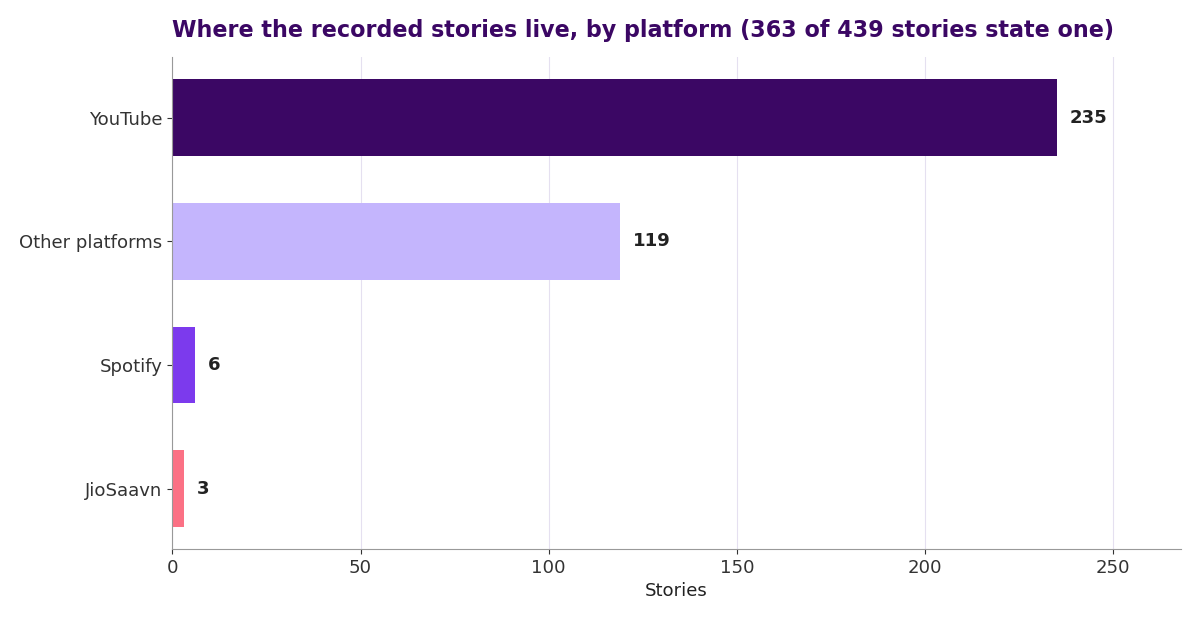
Our catalog records 439 stories, and 363 of them state a platform. YouTube holds 235 of those, about 65 percent, which is why it remains the default starting point: the Sunday Suspense archive and the Bhoot FM back catalog both live there. Another 119 stories sit in the catalog's other bucket, scattered across smaller apps, station sites and podcast feeds that no single name covers. Spotify, for all its polish, holds just 6 recorded stories, and JioSaavn holds 3.
That split explains the gaps listeners complain about. When two thirds of a tradition sits on one video platform, curation by mood, offline listening and a proper sleep timer all become afterthoughts bolted onto a video app. The dedicated apps exist to fix exactly that, and their catalogs are still small enough that the fix is a work in progress. A bedtime listener does not need another feed. She needs the right story, at the right length, on the platform already on her phone.

The scene is also a series scene. Of the 439 stories, 414 name a series, and one name towers over the list: Sunday Suspense accounts for 195 stories, about 44 percent of the entire catalog. Goppo Mirer Thek follows with 27, Friday Classics with 20, Kuasha Classic with 15, and Bhoot.com and Bhoot Studio with 13 each. Even inside horror alone, the platform pattern holds: of the horror stories that state a platform, 92 sit on YouTube. And the scene is young. The catalog's dated stories run from 2009 to 2026, and 81 of the 99 that state a year come from 2019 onward. Most of this tradition's recorded life happened in the last few years, on phones.
One more number keeps the map honest: 76 of the 439 stories state no platform at all. Part of this scene still lives in uploads, shares and group posts that nobody has catalogued properly, passed phone to phone the way the stories themselves once passed mouth to mouth. That is half the reason this catalog exists. A scene cannot be searched until somebody writes it down, platform by platform and narrator by narrator, and the writing down is still catching up with the listening. Until it does, every map of the scene, including this one, should carry the same footnote: counted from what the record states, and the record is incomplete.
Where this site fits in the scene
ShunoGolpo's part in the scene is the index and one small tool. The catalog exists so a listener can find a story by narrator, genre and length instead of by whatever an algorithm surfaces. It is also why the catalog keeps growing in public, corrections included, rather than pretending the map was finished on the day it was drawn. The tool is our free Horror Poster Maker: pick tonight's story, turn its title into a shareable horror poster in your browser, then go listen to it where it lives. If your nights run on a timer, our guide to the bangla story listening app with sleep timer question shows which story lengths each setting actually fits.
Start free on YouTube to learn your taste: vut or bhoy, Ray or Sharadindu. Move to a dedicated app when you realize you listen every night. The scene is young, growing fast, and the ghosts are multiplying.
Sources: Bengali Literature - Wikipedia