
You can know the ending and still get scared. That is the narrator's doing, not the plot's. Every bengali audio story you have ever replayed was carried by a voice first and a script second, and the numbers say the carrying is done by surprisingly few voices.
1. Mir Afsar Ali (Mir): the voice of Sunday Suspense. Timing, menace, and warmth in one sentence. Fifteen years of weekly episodes. 2. Deep (RJ): the co-pilot voice, steady and versatile, the other half of the classic pairing. 3. Sabyasachi Chakraborty and Paran Bandyopadhyay: the film actors who voiced the 2012 Sunday Suspense album. Screen presence translates to microphone presence. 4. The pause: great narrators scare you with silence, not volume. The beat before the door opens is the whole art. 5. The whisper: the best scares arrive quietly. Anyone can shout; it takes a master to murmur menace. 6. The proof: the same story read flat is boring. Voiced with sound design, it becomes a classic you replay yearly.
How few voices carry the catalog
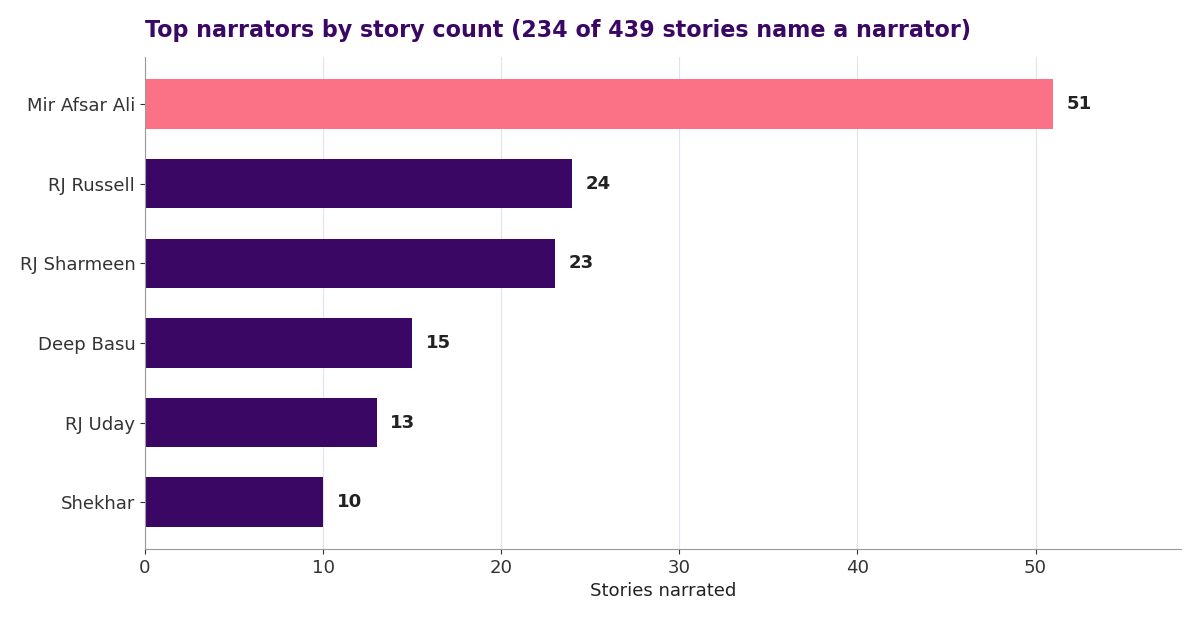
Count the narrators in our catalog and the art stops looking democratic. Of 439 stories, 234 name a narrator at all. Those 234 spread across 72 different voices, but the spread is steep. Mir Afsar Ali alone narrates 51 of them, more than a fifth of every narrated story we record. RJ Russell follows with 24 and RJ Sharmeen with 23. The top three voices between them carry 98 stories, about 42 percent of the narrated catalog. Add Deep Basu with 15 and RJ Uday with 13, and five voices account for 126 stories, nearly 54 percent. Shekhar, sixth with 10, completes a top tier that carries well over half the shelf.
This is not a complaint. It is the shape of the craft. Radio built a small guild of masters, and streaming inherited them. Studios record the voices that hold an audience at midnight, audiences return to the voices they trust, and the concentration deepens on its own. It also means the other 205 stories that name no narrator, and the long tail of 66 further voices sharing what is left, are where the next Mir is currently hiding.

One series explains much of the concentration. A full 195 of the 439 stories in the catalog belong to Sunday Suspense alone, the show that made Mir's voice the default setting for Bengali fear. When one program supplies nearly half the shelf, its narrator naturally becomes the voice of the whole tradition. Narration is also credited unevenly by genre: 108 of 199 horror stories name a narrator, as do 51 of 73 romance stories and 48 of 67 comedies, while only 25 of 98 thrillers bother. Horror, the genre of the voice in the dark, keeps the best records of whose voice it was.
Start with a name, not a title
When a new listener asks where to begin, the honest answer is rarely a story. It is a name. Start with Mir for the dread, Russell for the true stories sent in by listeners, Sharmeen for a late night session, and the catalog opens in the right order. Once a voice has you, follow it across genres; the same narrator reading romance or comedy will teach you more about the art than a dozen random titles. And when you settle on tonight's episode, our free Horror Poster Maker can give that voice's story a poster worth sharing, right in your browser.
And do not ignore the tail. Sixty six more voices share the 98 narrated stories the top six leave behind, most of them only one or two stories deep in the record. That tail is where scouts should live. Every master in the top tier was once a single-story name in somebody's catalog, untested at midnight, waiting for the pause that lands. The concentration at the top is the art's history. The tail is its future, and it is longer, and busier, than the headline numbers suggest.
Plot is what happens. Voice is what happens to you.
Choose your narrator the way you choose your story, and never underestimate the pause.Sources: Banglapedia, Bengali Literature - Wikipedia